About
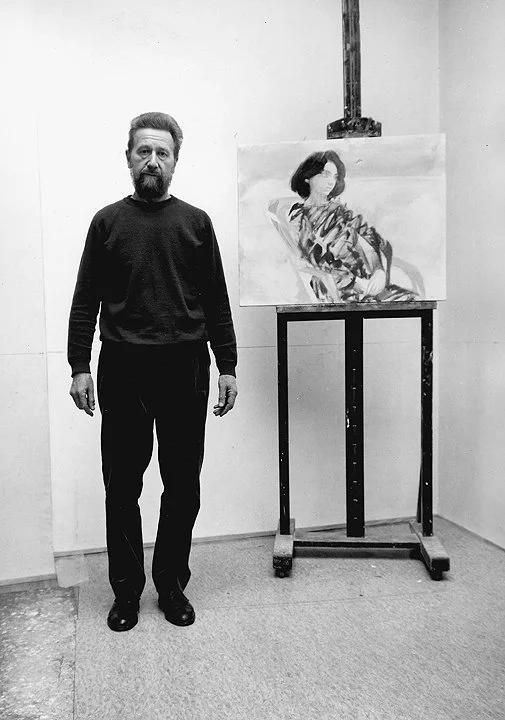
Daniel ‘Alain’ Brustlein in his Paris studio. Photo: Henri Cartier-Bresson / Magnum Photos
Daniel ‘Alain’ Brustlein (1904-1996)
Daniel 'Alain' Brustlein occupies a singular position in twentieth-century American art, bridging the worlds of illustration and modern painting with uncommon authority. Known professionally as “Alain,” he achieved distinction as one of the foremost illustrators in the United States, contributing incisive, elegantly drafted cartoons to The New Yorker and other major publications. Yet to regard Brustlein solely as a master of graphic wit would be to overlook the profound achievement of his later career: a body of figurative paintings that asserted the vitality of the human image at a moment when it was widely declared obsolete.
Born in France, Brustlein brought to American illustration a distinctly European refinement—economy of line, psychological acuity, and compositional clarity. His cartoons, signed simply ‘Alain,’ distilled narrative into gesture and glance, revealing a deep understanding of character through the subtlest inflection of contour. This early discipline in draftsmanship would become foundational to his painting practice. Even in his most painterly canvases, line retained a structural authority, anchoring figures within fields of chromatic energy.
By the early 1950s, as Abstract Expressionism ascended in New York and the figure was increasingly suppressed in favor of all-over abstraction, Brustlein turned deliberately toward the subjects of portraiture and landscape. At a time when gestural painting was often synonymous with non-objective form, he pursued a synthesis: retaining the human presence while embracing the immediacy and physicality of the brushstroke. Much like his contemporaries Milton Avery (1885-1965) and Fairfield Porter (1907-1975), Brustlein’s portraits of friends, fellow artists, and cultural figures are neither academic likenesses nor conventional society images. Instead, they are painterly constructions in which the figure emerges through a lattice of gestural marks—paint dragged, scumbled, and laid down with palpable urgency. His pursuit of the figure laid the path for a rising generation of artists that included Lois Dodd, Jane Freilicher, Alex Katz, and Larry Rivers.
In this regard, Brustlein’s work forms an important counter-current within postwar American art. His canvases affirm that figuration could coexist with, and indeed absorb, the innovations of gestural abstraction. Broad passages of color establish emotional climate; animated strokes describe the tension of a shoulder or the inwardness of a gaze. The human body becomes a site of painterly inquiry, where form is discovered rather than prescribed. This approach positioned Brustlein as a quiet but consequential innovator—one who demonstrated that the gestural mark need not obliterate representation but could instead intensify it.
Landscape, too, served as a vehicle for this exploration. Scenes from his travels—coastal vistas, village streets, interiors suffused with Mediterranean light—are rendered in a chromatic language that oscillates between observation and memory. The paint surface carries the record of its making, each stroke an event. Yet beneath this vitality lies the illustrator’s compositional intelligence: balance, rhythm, and narrative implication persist.
Today, Alain’s oeuvre stands as a testament to artistic independence. Moving fluidly between the printed page and the painted canvas, he forged a language in which wit, structure, gesture, and humanity converge—reaffirming the enduring power of the figure in the history of postwar American painting.
Brustlein’s transatlantic career was marked by significant monographic exhibitions at Galerie Jeanne Bucher, Paris (1952, 1988); Stable Gallery, New York (1955, 1959); Centre Culturel Américain, Paris (1962); Saidenberg Gallery, New York (1964); Galerie Jacob, Paris (1969, 1975); Livingstone-Learmont Gallery, New York (1977); A.M. Sachs, New York (1980, 1981); Gruenenbaum Gallery, New York (1984); Kouros Gallery, New York (1990, 1997, 1999, 2002); and ACME Fine Art, Boston (2011).